Uncategorized

How a skilled waiter is like a good speaker

I once sat in a five star restaurant in Paris and watched a waiter move through the room. He moved as if he were on skates, gliding so smoothly, with such balance, that it was a pleasure to watch him.

As he put the food down on each table, he said something to the people sitting there. Each diner’s face would light up as the waiter spoke. I watched the other waiters, and no one seemed to be having the same impact on the people they were serving. I caught this waiter’s eye, and he came over to my table at once.

“May I help you, m’sieur?”

“I know this sounds like a strange question,” I said, “But I’ve been watching you, and you seem to be having a huge impact on the people in this room. What are you saying to them?”

He smiled. “As a young man, when I first came to work in a fine restaurant, I was instructed by the head waiter to say ‘Bon appetit’ after I served each table. Because I was in such a rush, I would usually just put the plates down, repeat ‘Bon appetit,’ and leave quickly. One day I noticed that there was one second, after I put the plate down, when the diners would look up at me. I found that in that moment, I could look into their eyes, say ‘Bon appetit,’ and mean it. I could tell them without words, ‘I wish that you have a good meal. I want you to be happy.’ Through this simplest gesture, I could make them feel wonderful. It took only a moment to do this, to put the plate down in front of them as if I had cooked it myself. I went from serving food, to serving a sacrament. I am the most fortunate of men, m’sieur. What an honor it is to host a meal, to bring nourishment to people, to offer things that brought them joy and delight! That’s where I learned that with the right intention, you can transform anything into the opportunity to give a gift.”

This is good news for you as a speaker. What it means is that you don’t have to be perfect. Your intention to give a gift trumps the necessity to be flawless. Yes, it’s nice to get the words right. But it’s okay to flub a line, or to make a mistake, because it’s the overall experience that will linger in their mind.

Uncategorized

Free Webinar with Peter Meyers

Are you worried about your team, your organization, your job and your future? Are your colleagues and customers anxious and disengaged?

I can assure you you’re not alone.

In these uncertain times, the biggest risk isn’t in the volatility of any market or currency or government — the biggest risk is in letting your people and your customers get stuck. Stuck in their fear, stuck in their doubts, and stuck in a mindset of retreat.

Lately I’ve been receiving calls and emails from clients and colleagues who are on-edge and exhausted from dealing with demotivated and disengaged teams. They’ve been clamoring for advice on how to communicate during crises. They want to know there’s a way to navigate through these tough times and come out on the other side, excited to meet the next challenge.To offer some insight, I’ll share with you the lessons I’ve learned during the past decade of coaching Fortune 100 leaders and their teams around the world:

On Monday, Sept. 19th and Tuesday, Sept. 20, I’ll lead a FREE Webinar on Crisis Communication.

The Most Important Lessons You’ll Learn in this FREE Webinar:

Why you are hard-wired to fail during moments of distress.

How you can avoid the three most common pitfalls of crisis communication.

How great leaders bring people together in the face of adversity — and the critical tools you can borrow from them.

FREE Webinar with Peter Meyers “How to Avoid the Three Fatal Mistakes in Crisis Communication”

WHEN:

Monday, Sept. 19th, at 8 a.m. PST (3:00 GMT)

or

Tuesday, Sept. 20, at 7 a.m. PST (2:00 pm GMT)

The Webinar will be quick–50 minutes–and powerful. Join us if you want to change how you handle change.

COST: FREE

Email Casondra Prince (casondra@standanddelivergroup.com), to let her know which session you’d like to attend. She’ll send you a link. It’s as easy as that.

In this Webinar I’ll also share an important story with you — one that will save you an untold amount of time and stress. When we worked with a major international financial institution (who shall, of course, remain anonymous), they were facing a moment of reckoning — a crisis that threatened their very existence. At the eleventh hour, we developed a concrete plan for crisis communication. They stuck to the plan, made it through the crisis, and today that organization is thriving.You don’t need to wait for an hour of darkness to figure out a what to do — I’ll share with you the tools we developed to communicate during their moment of truth.

If you’re curious how to solve problems, avoid paralysis and drive growth and innovation now, you should join us in this free Webinar.

Uncategorized

Kay Kostopoulos and “Acting with Power”

Emotion comes from motion.

While we often think of the mind controlling the body, in reality it’s often the other way around. The way we hold our bodies and faces has a tremendous effect on our psychological state.

No one understands this better than Stand & Deliver faculty member Kay Kostopoulos, who teaches in several departments at Stanford University. This month, Kay is featured in an “O.” magazine story about the ways that “physical adjustments can profoundly alter the course of an interaction.”

Here’s an excerpt:

Like many other species, humans tend to behave in either a dominant or deferential manner—a preference that’s determined by some combination of our personality and ingrained expectations about where we belong in the social pecking order (expectations conferred by gender, class, birth order, geographic origin, and so on). It’s easy to get stuck in character, perpetually enacting roles we didn’t consciously choose. (Picture the overly smiley coffeepot replenisher at work who’s also a doormat at home.) But this afternoon, Gruenfeld and her co-teacher, drama instructor Kay Kostopoulos, aim to help us shed the automatic physical habits that go along with those roles.

Read the full story here!

Book Reviews, In The Media, Presentation Tips, Uncategorized

How’s Your Breathing?

One of the best ways to gauge your own state is to check your breath: When you’re inspired, you’re full of breath. (When you’re out of breath, you’re expired).

How are you breathing today? At this very moment? Are you inhaling deeply? Or are you short of breath?

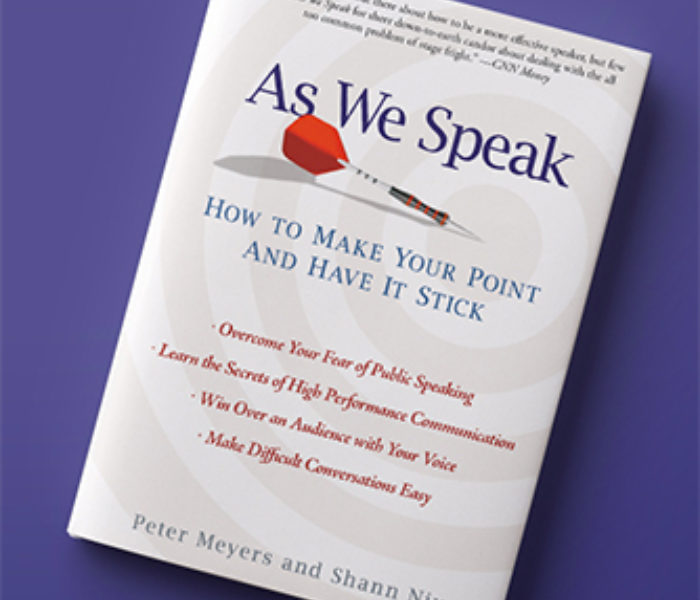
We’re inspired today by the re-launch of the Stand & Deliver web site and the publication of As We Speak.

To mark this moment of inspiration, I thought it would be appropriate to return to the breath. As We Speak is meant to inspire you to achieve breakthroughs in your own leadership and communication. But the book is also about the physiology of inspiration — about how to manage your own emotional and psychological state through control of the breath and body. Here is a short excerpt from the book about breathing. I hope you find it useful — and inspiring.

When we work on voice, we begin with breath. Your voice is carried by your breath. Put one hand on your chest, and one hand on your belly. When you breathe, notice which part pushes out. If, when you inhale, your chest goes out and your belly goes in, you are doing what we call “chest breathing.”

Now practice breathing so that when you inhale, your belly pushes out against your hand as it fills with air. When you do this, a powerful muscle called the diaphragm flexes down, allowing the oxygen to reach the lower capillaries in your lungs. When you breathe out, the diaphragm flexes up, emptying your lungs. This is called abdominal breathing, and it is the type of breathing that professional singers and actors use to support their voice.

When some people get nervous, their chest and throat tightens up like the neck of a balloon. This will impede your airflow. As you breathe, consciously relax your chest and throat. You can drop your volume, speak very quietly, and still have a round, fat sound that is easily heard.

You don’t have to speak louder; you just have to be more generous. Focus on taking in more air and releasing your breath with the sound. The opposite of generous is stingy, and it comes from holding your breath, as if you were keeping the idea to yourself. The tension in your breathing creates tension in the audience. Release your breath fully, and it will carry the idea.